
by Saiyare Refaei of Just Seeds
“We go to Cuba to be changed.” – Dr. Molly Benitez, returning Brigadista
In the entrance hall of the Cuban Institute of Friendship with the Peoples (ICAP), Saiyare reads from a little brown field book wearing a green dress:
Hi everyone, my name is Saiyare. My pronouns are they/she and I reside on occupied Puyallup lands (Tacoma, Washington). We are the 53rd Venceremos Brigade comprised of 28 brigadistas ranging from 16 to 51 in age. For 55 years this antimperialist project, the Venceremos Brigade, is the oldest brigade in solidarity with the Cuban people.
Hola tides, mi nombre es Saiyare. Uso los pronombres elle y ella. Y resido en las tierras ocupadas de la tribu Puyallup en Tacoma, Washington. Somos la quincuagésima tercera Brigada Venceremos con que tiene veintiocho brigadistas de 16 a 51 años en edad. Por 55 años, este proyecto antimperialista, la Brigada Venceremos, ha sido la brigada más antigua en solidaridad con el pueblo cubano.
As a queer person of Iranian and Chinese descent, I see our struggles connected. It’s an honor to be on liberated soil with this first and historic queer and trans brigade. We are here to learn, to bring material aid, and support the Cuban people in the ways we can. We demand an end to the economic blockade, the U.S. imposed travel restrictions and regime change programs.
Como personas queer de ascendencia irani y china, veo que nuestras luchas están conectadas. Es un honor estar en suelo liberado con esta primera e histórica brigada queer y trans. Estamos aquí para aprender, traer ayuda material y apoyar al pueblo cubano en las formas que podamos. Exigimos el fin del bloqueo económico, las restricciones de viaje y los programas de cambio de régimen impuestos por los Estados Unidos.
We demand an end to the illegal military occupation of Guantánamo Bay. We demand that Cuba be removed from the U.S. list of state sponsors of terrorism. We want to strengthen movements for justice in the U.S. through exchange and collaboration with Cuba.
Exigimos el fin de la ocupación militar ilegal de la base de Guantánamo. Exigimos que Cuba sea eliminada de la lista estadounidense de paises patrocinadores del terrorismo. Queremos fortalecer los movimientos por la justicia en los Estados Unidos a través de intercambios y colaboración con Cuba.
¡Venceremos!
¡Cuba sí, bloqueo no!
About the Venceremos Brigade
In a true act of solidarity with the Cuban people and their revolution, young people from various organizations banded together in 1969 to form the “Venceremos” (We Shall Overcome) Brigade. They sought to be in solidarity with the Cuban people and their revolution, and to challenge the U.S. travel ban and material impacts of the economic blockade by traveling to Cuba, harvesting sugar cane, construction and other manufacturing work. The first brigades were as many as 700 brigadistas who arrived in Cuba on converted cattle ships.
The Venceremos Brigade (VB) aims to:
- End the blockade on Cuba, all US-imposed travel restrictions, and all regime change programs
- End the illegal US military occupation of Guantánamo Bay
- Remove Cuba from the U.S. State Department’s list of State Sponsors of Terrorism
- Strengthen movements for justice in the U.S. through exchange and collaboration with Cuba
It’s been fifty five years in this brigade’s history and many more solidarity brigades have formed as well. This summer we led the first queer and trans Venceremos Brigade. There was a time in the history of the Venceremos Brigade that it was taboo to be “out.” It’s taken years to arrive at a place of centering LGBTQIA+ people. This intentional brigade also sought to connect queer and trans people living in the United States with Cubans focused on supporting the LGBTQIA+ community.
In September of 2022, a referendum was passed for a new Families Code that amplified the Cuban constitution to include language that challenges discrimination and extends further rights for women, queer and trans people, children, and essentially all Cubans. It took several years and a demonstration of deep democracy, with community conversations all across the island nation, and with experts in these fields to enhance these new progressive codes.
One of the organizations we met at the center of the community education after the new Families Codes were passed is Centro Nacional de Educación Sexual
(Cenesex) translated to the National Center for Sexual Education. Cenesex may be best known for advocating for LGBTQIA+ rights. They also organize quarterly jornadas (or workshops) in every province with partnering organizations. This past year the jornadas have included subjects such as: maternity and paternity rights and responsibilities, sex education, initiatives against transphobia, and against gender based violence. They also provide services for children who have been sexually abused, women who have experienced sexual violence, as well as services for orientation and sexology therapy. Cenesex is an organization that LGBTQIA+ Cubans go to if they feel their rights have been violated. These new codes make discrimination a crime and so they are continuously educating people on their rights before deciding whether to take legal action.
The Families Code was more so highlighted in international news because same sex marriage passed with this referendum. The code included legalizing the ability for same sex couples to adopt children. Other important additions to the Families Codes include that other forms of union are recognized. Generally Cuban people are less likely to get officially married and so they have not recorded a drastic uptick in same sex marriages.
You can read more about the new Families Code in a recent publication titled “Love in the Law: Cuba’s Queer Rights’ Revolution” edited by Gregory E. Williams. This book includes a presentation by Cenesex director Mariela Castro Espín, a discussion with a Cuban transmasculine activist, reports by LGBTQ+ delegation to Cuba, the full text of Leslie Feinberg’s “Rainbow Solidarity in Defense of Cuba,” and more.
International Solidarity
The timing of this brigade coincided with 26 de julio, a national holiday commemorating a young group in arms led by Fidel Castro to take on el Moncada Garrison, an armory of the Batista dictatorship in Santiago de Cuba. Though a failure in many ways with some casualties, this action was an impetus for the Cuban revolution. We convened in an encuentro de solidaridad with around 300 internationalists from 25 different brigades to show our solidarity with the Cuban people. Speeches were made by representatives from various brigades and solidarity organizations followed by a speech from President Miguel Díaz-Canel Bermúdez.
The next morning was the ceremony commemorating el 26 de julio with all the brigade representatives and boarder community to hear speeches from local representatives and various performances.
Artist Feature
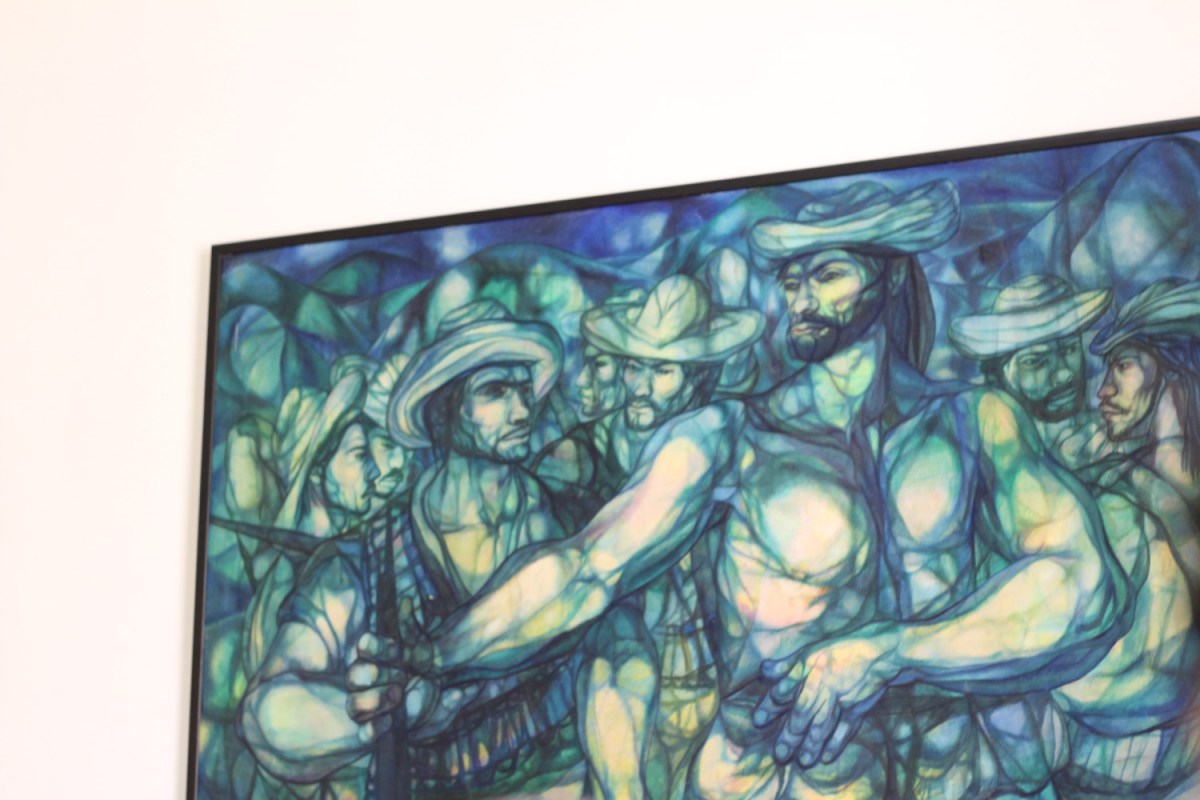
Often when we think of Cuban art, we think of revolutionary propaganda art. Since this brigade was centered around LGBTQIA+ identities and initiatives, on our last full day in Cuba, we visited el Museo Biblioteca de Servando Cabrera Moreno. Moreno (1923-1981) came up studying and making fine arts. His life work is categorized in five cycles and stages: Academia, Guajiros del Megano, Abstraccionismo y Juguetes, Milicias Campesinas, Expresionismos and Erotismo. Especially in his era of Milicias Campesinas (Farmer Militias) he focused on representing the everyday Cubans. Some of his paintings in the 1960s and 1970s are examples of this. Many of these paintings depict farmers in straw hats armed with machetes. He even has one painting titled “El Brigadista Benjamin,” a tempura painting on cartulina (cardboard) from 1978. His era of Expresionismo (Expressionism) and Erotismo (Eroticism) was in the closet for much of his life. These pieces exemplify ungendered and intertwined bodies. Much of his queer and sex positive art was censored during the time of their creation. El Museo Biblioteca de Servando Cabrera Moreno is dedicated to honoring his artistic journey and making amends to this history. Prime examples of queer Cuban fine art.
Support the Venceremos Brigade
We go to Cuba as a radical act of solidarity with the Cuban people. We know the U.S. government is suppressing the Cuban economy in hopes that the people will overthrow their current government. We want Cuba to be their own self-sustaining nation and be an active participant in the global economy. When we go to Cuba we are deeply moved by the way community care and love is at the center of the culture and praxis. As brigadistas we struggle together, one of the hardest lessons of our time together. We return to the United States knowing what is attainable, that a better world is possible, and that much work is yet to be done here for us to arrive at such a way of being. Cuban revolutionaries are everyday people who teach us radical optimism, discipline, selflessness, sacrifice and love. Cuba is love.
The Venceremos Brigade’s Points of Unity are:
- We believe in Cuba’s sovereignty and right to self-determination.
- We believe in the constitutional right of US citizens to travel, move and freely associate.
- We believe in internationalist struggle and solidarity.
- We believe in building equity and justice in the struggle against capitalism, racism, patriarchy, and colonialism.
- We believe that people are not disposable.
You can learn more about the brigade at vb4cuba.com or on Instagram at @vb4cuba. There are also local chapters across the United States, there may be one near you. The Venceremos Brigade is an all volunteer run initiative. If you wish to support the brigade and make funds available for scholarships for future brigadistas please donate here.
Thank you to members of the Venceremos Brigade’s Pacific Northwest Local Committee and National Coordinating Committee who took the time to review and add suggestions for this blog post. Any errors are Saiyare’s alone.
 Venceremos Brigade